Showing posts with label italy. Show all posts

Monday, December 25, 2023

Review: The City of the Living by Nicola Lagioia

Synopsis: In March 2016, in an apartment on the outskirts of Rome, two “ordinary” young men brutally tortured and murdered twenty-two-year-old Luca Varani. News of the seemingly inexplicable crime sent shock-waves across Rome and beyond.

After the crime comes to light, Lagioia begins investigating the crime by meeting with the victim’s family and corresponding with one of the killers. It soon becomes clear, however, that to investigate this crime means to descend into the darkest corners of Rome and of the human psyche.
Lagioia leads us through a maze of betrayed expectations, sexual confusion, economic grievances and identity crises to locate the breaking point, the point after which anything is possible.

Sharp, hypnotic, devastating, The City of The Living is not just the story of a crime, but of human nature the tension between responsibility and guilt, between the drive to oppress and the desire to be free, between who we are and who we can become.

~ ~ ~

An auto-fictional account of a much publicised murder that occurred in 2016 in Rome, Italy. The first part of the account, told in the third person narrative, deals with the crime, the arrest. The second part, told in the first person narrative, continues on, and is punctuated by personal recollections and statement of friends. The reconstruction includes legal proceedings, reports, interviews and other evidence. It is written in a style that sort of plays out events as they are happening.

Unfortunately, I was not at all engaged with the writing style or presentation. I did persevere till the end but there really was no really interest except to finish.

Tuesday, August 31, 2021

Review: Echoes of War by Tania Blanchard

Synsopsis: Set in Mussolini’s Italy amid great upheaval, this is the story of one woman’s determination to find her place in a world that men are threatening to tear apart. Another heart-rending novel inspired by a true story from Australia's bestselling author of The Girl from Munich.

Calabria, Italy, 1936 - In a remote farming village nestled in the mountains that descend into the sparkling Ionian Sea, young and spirited Giulia Tallariti longs for something more. While she loves her home and her lively family, she would much rather follow in her nonna’s footsteps and pursue her dream of becoming a healer.

But as Mussolini’s focus shifts to the war in Europe, civil unrest looms. Whispers of war are at every corner and her beloved village, once safe from the fascist agenda of the North, is now in very real danger.

Caught between her desire to forge her own path and her duty to her family, Giulia must draw on the passion in her heart and the strength of her conviction.

Can she find a way to fulfill her dreams or will the echoes of war drown out her voice?


Unfortunately not for me.

The main character grated on me - she was way to modern for the period. The narrative dragged on without really much happening then jumped about ten years in the very last part.

In the end I could sum up the whole book in one famous sentence by French writer Jean-Baptiste Alphonse Karr, who wrote “plus ça change, plus c'est la même chose “ – the more things change, the more they stay the same - which was also the theme of The Leopard.

As a side note, I noticed the same theme running through all her other books - is this a good or bad thing, or just complacency?

Tuesday, August 11, 2020

Review: The Borgia's Spy by Andrea Frediani

The Borgias' Spy: An unputdownable, gripping thriller
Synopsis: 1497. Pope Alexander VI Borgia is perfecting his plans for the control of Italy when a heinous crime deprives him of one of the people dearest to him. All of Rome is mobilised to discover the perpetrator but a strange series of coincidences means famous court painter Pinturicchio finds himself on the front line.

To shed light on a murder that has cut the papacy to the quick, Pinturicchio is assisted by the city's most established artists, from Michelangelo Buonarroti and Filippino Lippi to Piermatteo d'Amelia and Perugino. The Borgias have so many enemies that the list of suspects grows by the day, but a masked man may be the key witness to the crime – or even its perpetrator...

Andrea Frediani brings one of the most famous cold cases in history to life in this thrilling tale of intrigue and deceit set in Renaissance Rome.


I love both fiction and non-fiction books featuring the Borgias - so I was looking forward to this story set around the time of the murder of Giovanni (Juan) Borgia.

It was a fascinating take on the mysterious and unsolved murder of Giovanni - there will be no spoilers here. Creative use of the artists of the day to contribute to the narrative for the search of those responsible. This also provided the reader with a glimpse at the intrigue and corruption that was prevalent at the Papal Court (and not just under the Borgias).

The thing that irritated me the most was that my edition needed serious editing / formatting - you finish one sentence in one place only to start the next sentence somewhere else with an entirely different character - it was very annoying and required the need to re-read paragraphs to ensure you knew where you were in the storyline. My edition also had some passages highlighted.

If these formatting issues are dealt with, this will make for a very good read. There is also an authors's note at the end that will be of interest to readers.

Saturday, June 27, 2020

Reviews: Death in a Bookstore: An Inspector De Vincenzi Mystery by Augusto de Angelis

Death in a Bookstore: An Inspector De Vincenzi MysterySynopsis: When the clerk arrived to unlock the bookstore on Via Corridoni, the last thing he expected to find inside was a dead Senator. 

Now Inspector De Vincenzi has been assigned the case and the only clue is a missing copy of a rare book, La Zaffetta, taken from the room where the Senator lies dead. The Senator's murder is a live hand-grenade with no pin and the Superintendent has given Inspector De Vincenzi eight days to solve the murder . . . or else. As the bodies begin to pile up, supernatural forces seem to be at work. But it was no spirit that put a lead slug in the back of Senator Magni’s head.

Death in a Bookstore, one of De Angelis's best novels, is a psychological tour de force. Inspector De Vincenzi, "the first authentic Italian detective," doesn't just track down clues, he gets inside the heads of his suspects, with often stunning results. “You disregard evidence . . . appearances . . . earlier crimes. You disregard motives. You observe people, question them, examine them, judge them with your psychological method and then set them free, having decided that they cannot be guilty, because they lack the moral, intellectual, temperamental, or emotional capacity to commit a murder, this murder . . . Where will we end up, De Vincenzi? Your obsession with the psychology of murder is madness!”

While new to English readers, Inspector De Vincenzi is immensely popular in Italy, and is the protagonist of several best-selling novels as well as two Italian television series.


Yet another engaging journey into 1930s Milan and a crime involving the discovery of a body in a bookstore. Inspector de Vincenzi slowly pieces together the puzzle and lamented that "... this is one of those knotty cases, in which taking a false step means going back to the beginning ..". But we know that in the end, de Vincenzi will solve this crime.

Image result for augusto de angelisWhat I appreciated was the Foreward - this is a must read in itself, for we discover that under Mussolini, the detective novel was not only seized but destroyed, and de Angelis himself was a victim of the fascist dictator.


also by Augusto de Angelis:
> The Mystery of the Three Orchids
> The Hotel of the Three Roses
> The Murdered Banker

further reading:
> Politics and Society in Italian Crime Fiction: An Historical Overview by Barbara Pezzotti
> The Importance of Place in Contemporary Italian Crime Fiction: A Bloody Journey by Barbara Pezzotti


Thursday, September 13, 2018

The Chef's Secret: A Novel by Crystal King

A captivating novel of Renaissance Italy detailing the mysterious life of Bartolomeo Scappi, the legendary chef to several popes and author of one of the bestselling cookbooks of all time, and the nephew who sets out to discover his late uncle’s secrets—including the identity of the noblewoman Bartolomeo loved until he died.

When Bartolomeo Scappi dies in 1577, he leaves his vast estate—properties, money, and his position—to his nephew and apprentice Giovanni. He also gives Giovanni the keys to two strongboxes and strict instructions to burn their contents. Despite Scappi’s dire warning that the information concealed in those boxes could put Giovanni’s life and others at risk, Giovanni is compelled to learn his uncle’s secrets. He undertakes the arduous task of decoding Scappi’s journals and uncovers a history of deception, betrayal, and murder—all to protect an illicit love affair.

As Giovanni pieces together the details of Scappi’s past, he must contend with two rivals who have joined forces—his brother Cesare and Scappi’s former protégé, Domenico Romoli, who will do anything to get his hands on the late chef’s recipes.

Monday, June 11, 2018

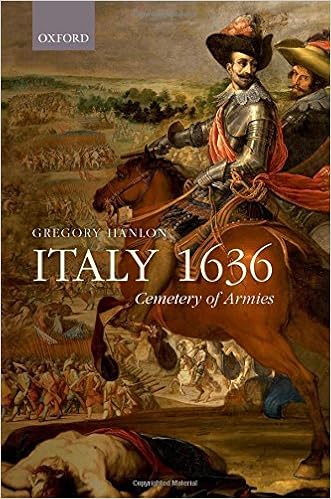
Italy 1636 by Gregory Hanlon

From Amazon: 
Italy 1636 is one of the most closely-researched and detailed books on the operation of early modern armies anywhere, and is explicitly inspired by neo-Darwinian thinking. Taking the French and Savoyard invasion of Spanish Lombardy in 1636 as its specific example, it begins with the recruitment of the soldiers, the care and feeding of the armies and their horses, the impact of the invasion on civilians in the path of their advance, and the manner in which generals conducted their campaign in response to the information at their disposal. The next section describes the unfolding of the long and stubborn battle of Tornavento, where Spanish, German, and Italian soldiers stormed the French in their entrenchments, detailing the tactics of both the infantry and the cavalry, and re-evaluating the effectiveness of Spanish methods in the 1630s. The account focuses on the motivations of soldiers to fight, and how they reacted to the stress of combat. 

Gregory Hanlon arrives at surprising conclusions on the conditions under which they were ready to kill their adversaries, and when they were content to intimidate them into retiring. The volume concludes by examining the penchant for looting of the soldiery in the aftermath of battle, the methods of treating wounded soldiers in the Milan hospital, the horrific consequences of hygienic breakdown in the French camp, and the strategic failure of the invasion in the aftermath of battle. This in turn underscores the surprising resilience of Spanish policies and Spanish arms in Europe. In describing with painstaking detail the invasion of 1636, Hanlon explores the universal features of human behaviour and psychology as they relate to violence and war.

read more here @ H-Net Reviews

Sunday, April 1, 2018

Review: The Black Prince of Florence by Catherine Fletcher

The Black Prince of Florence: The Spectacular Life and Treacherous World of Alessandro de’ Medici
The story of Alessandro de Medici, Duke of Florence (r.1532 - 1537).

Having read much about the de Medici, I was instinctively drawn to this tome about one of the more obtuse characters and another case of where fact far outstrips fiction.

Born on the wrong side of the blanket, Alessandro emerged on the tempestuous political scene of Renaissance Florence at the same time as another incorragable character - his kinsman and bitter rival, Ippolito.

Florentine politics was dominated by family, money and the Church - these were the main avenues of power, and the de Medici had all three in spades. And it was against this backdrop that bitter and bloody family rivalries were played out along side the scheming intrigues of the city's oligarchs, who strove to keep power out of the hands of the de Medici.

The de Medici, however, were favoured by the Church - first, Giovanni de Medici (Pope Leo XI) and then the equally illegitimate Guilio de Medici sat upon the papal throne as Pope Clement VII (whose son he was reputed to have been).  Like most nepotistic popes, Clement was able to obtain a Cardinal's hat for Ippolito (much to his chagrin for he also wanted to rule Florence), and a politically advantageous marriage for Alessandro (to the illegitimate daughter of the Holy Roman Emperor Charles V).  What we have now is a powerful ruler, whose illegitimacy in no way proved to be a political barrier.


From extensive research, Fletcher successfully debunks many of the myths surrounding this enigmatic man. We find that Alessandro, far from being a fool, a cruel tyrant, a murderer (as his was often portrayed), was scholarly, engrossing, charming, and a patron of the arts. We also find that the colour of his skin was in no way an issue during his own lifetime for his friend and foes alike - that came much later. His life was indeed full of feuds, assassinations (including his own at the hands of yet another de Medici cousin), duplicity, jealousy and betrayal - that was merely business as usual, and was no different from other parts of Renaissance Europe.

Fletcher provides a sympathetic work of a forgotten and much maligned prince. The writing is dramatic, yet entertaining, suspenseful, and accessible. A worthy addition to anyone's personal library.


Saturday, April 29, 2017

Death, Cinema & Post War Italy

From The Spectator - reviews of two books on post-war era Italy:

Dolce Vita Confidential: Fellini, Loren, Pucci, Paparazzi and the Swinging High Life of 1950s Rome by Shawn Levy
Shawn Levy .... turns his attention to the regeneration of post-war Rome. It starts in 1953 with a half-naked female corpse washed up on a beach outside Rome. The drowning was put down to misadventure, though why Wilma Montesi should have been missing her stockings and suspender belt was never satisfactorily explained. Levy chronicles the investigation, the rumours and the scandal but, like others before him, fails to draw meaningful conclusions.

Cinecittà, the home of Italy’s film industry, was the third largest employer in Rome after the Church and the government. These were the years of Hollywood sul Tevere. Day after day they filed into the city, the actors, extras, troupes of dancers and make-up girls. Cinecittà welcomed them all — the foreigners with hard currency, the fly-by-nights, the star-struck suburbanite wanting her moment in the sun.

Italian Cinema: Arthouse to Exploitation by Barry Forshaw
In Barry Forshaw’s history of Italy’s cinematic traditions, he sees sex and individualism as key motivating factors. He explores the spaghetti sesterns and gialli (thrillers) and the video nasties, or horror flicks, pioneered by Dario Argento. (Sexualised female corpses feature heavily and controversially.)


Read entire article by Lilian Pizzichini here @ The Spectator

See also:

Saturday, May 26, 2012

New Arrivals

Over the last week some new arrivals landed on my doorstep - books of course!


The Last Duel by Eric Jager - finally have my own copy of this must read book of "crime, scandal & trial by combat in medieval France".
Margaret Beaufort by Elizabeth Norton on the "mother of the Tudor Dynasty".
Catherine de Medici by Leonie Frieda - have loved this book of Catherine for some time.
Dairmait, King of Leinster by Nicholas Furlong - on the protagonist of the Anglo-Norman invasion of Ireland.
Queen Margaret of Scotland by Eileen Dunlop.
The Borgias by Christopher Hibbert - one of my favourite renaissance families.
Peace-Weavers & Shield Maidens: Women in Early English Society by Kathleen Herbert.
The Trial of Gilles de Rais by Georges Bataille - one of my favourite medieval villains.

Much reading planned - providing I don't spend the rest of the day ordering more books!