Monday, December 24, 2018

Review: Mala Vida by Marc Fernandez

Mala Vida: A Novel
In a dark and often overlooked chapter of General Francisco Franco’s 1939-75 dictatorship, the newborns of some left-wing opponents of the regime, or unmarried or poor couples, were removed from their mothers and adopted. The practice was later expanded. New mothers were frequently told their babies had died suddenly after birth and the hospital had taken care of their burials, when in fact they were given or sold to another family.

A line from the novel - no, this real life drama was being played out today as 85yo Eduardo Vela, who worked as a gynaecologist at the now-defunct San Ramón clinic in Madrid, arrived in court to face charges of taking a child from her biological mother and giving her to another woman, falsifying birth records in the process. The system – which allegedly involved a vast network of doctors, nurses, nuns and priests – outlived Franco’s death in 1975 and carried on as an illegal baby trafficking network until 1987 when a new law regulating adoption was introduced.

So this then is the premise of the story. However, we only discover this after a few chapters in as we are at first deceived into thinking that this is a political murder mystery with links back to the Franco era, due to the alternating narrative between the unnamed assassin and Diego Martin, the investigative journalist (and late night DJ).

This extremely controversial subject is tackled well, though I can't help thinking that this could have been teased out a little longer over a few more pages - all too soon certain anomalies are cleared up and the conclusion arrives all too neatly.

Having said that, this was a nice blend of historical fact and crime fiction.

read more here


Review - Unquiet Women by Max Adams

Unquiet Women: From the Dusk of the Roman Empire to the Dawn of the Enlightenment
I read this one a couple of days before Pamela Toler's "Women Warriors" - and to be perfectly honest, I feel like cutting and pasting my review of that book here.

A " ... crafted patchwork of the forgotten lives of some of the most remarkable women in history ..." - only if this is not your area of interest. If it is, then this is merely a collection of things of interest to the author and organised in some sort of chapter according to their subject matter. To me personally, it reminded me of a blog that has been published as a book - some random biographies presented with archaeological discoveries and local histories to add some additional flavour.

Again, as with Toler's book, I have covered off over half of the content in my own blog and have read the very same biographies and internet articles (as I assume anyone with the remotest interest in this area would have also).

Quote: Unquiet Women brings to life the experiences of women whose voices are barely heard and whose stories are rarely told. - sorry, but the last have dozen years (if not last decade) has seen a considerable surge in this type of research, with numerous books, blogs, articles, etc, giving voice to any number of "invisible women" that you could practically trip over it with every corner turned.

Another no star rating here - I was rather bored, having a constant sense of deja vu the more I read.


Review: Women Warriors by Pamela D Toler

Women Warriors: An Unexpected History
The author states her intent is to bring women warriors out of the historical shadows; to consider the reasons that they have taken up arms and how those reasons related to their roles; and the consequences of their actions.

I am actually going to be very blunt here - this is very basic stuff that a good google search can produce. I myself have written about over half the women mentioned; have read the same books; have read the same internet articles. And if this is your area of interest, then you also have already - so nothing new, no "unexpected history". I could literally just publish my own blog - Women of History - as a book (which is what this looks like to me - at times I felt as if I was reading my own works).

There are lots of snappy titles - "father's daughter", "widows", queen" - you get the gist - but I felt it could have been better organised. Yes, there is a great spread of warrior women across time, but it is presented in a hodge-podge sort of way (under the snappy titles) rather than in chronological order. Had the author (editor, publisher) maybe presented the work in this way, we the reader may have been able to see more of a development in the ways women took to the battlefield. You don't unfortunately get this - just some randomly arranged biographies interspersed with some commentary and biographies that don't really seem to fit under any the chapter. We finish with a dozen or so references - six biographies - though the notes are a little more extensive.

No star rating from me - I surprised myself by even finishing it to be perfectly honest.

Please bear in mind that this is my review of the book and its presentation, not the author; I know how huffy people can get in defending their favourite authors.

I would be very interested in the thoughts of those for whom this area is something completely new.


Saturday, December 15, 2018

Review: Heir Apparent by James Terry

Heir Apparent: A Novel
"... everything was exactly as it had been at some other time, in some other life .."

A truly well crafted mystery with shades of Sophocles' "Oedipus Rex" forming the backbone of the narrative, but instead of ancient Greece, this is set in modern times, where the main character seems to have stepped off the pages of a Mickey Spillane or Raymond Chandler novel.

There is so much going on in the periphery that it seems, at first like, like white noise. Then the clues start dropping, discreetly, unobtrusively, unnoticed. The characters begin to shape, solidify and conform, and the plot takes on the resonance of the classic Greek tragedy. The further we traverse the pages, the more the path twists and turns, sending us hither and thither, before, like an ancient oracle, the story is revealed.

A true page-turner ... wherein even our narrator, cannot tear himself away from the very pages of the story being laid bare before his own eyes. And thus the narrative comes full circle - the alpha becomes the omega or is it the other way around???.


Penn library will return 9th-century documents found to have been stolen from Italian archive

From The Inquirer:

The University of Pennsylvania has voluntarily agreed to return two ancient parchment documents to an Italian archive from which they had been stolen, apparently in the 1990s, according to a formal stipulation filed in federal court in Philadelphia last month.

The heist was the work of an unknown thief and happened years before the papers surfaced at Penn.

The documents, which record land transactions in the 820s in southern Italy, were acquired in the late 1990s by the late collector Lawrence J. Schoenberg, who bestowed his collection of manuscripts and books on the university in 2011.

The Schoenberg Collection at the University of Pennsylvania Libraries, consisting of about 300 separate items, is particularly rich in medieval and Renaissance books and manuscripts.


read more @ The Inquirer

Local author publishes book on Robin Hood

From the Wiltshire Times:

Dr Sean McGlynn says the legend of the Nottingham outlaw who reportedly robbed the rich to give to the poor has Wiltshire connections.

His new book Robin Hood: A True Legend has already received international media attention.

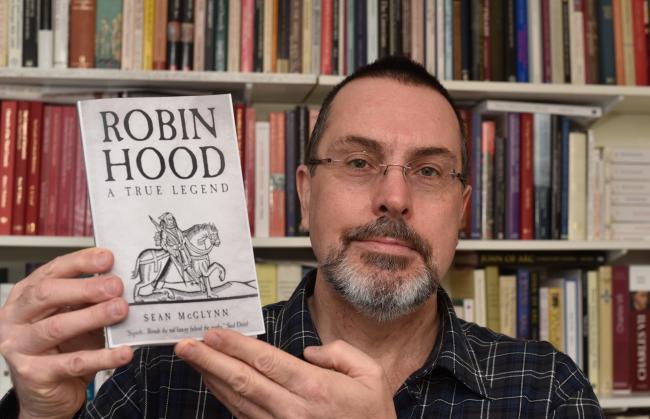
Author Sean McGlynn of Monkton Farleigh with his latest book, Robin Hood -A True Legend.Photo by www.gphillipsphotography.com GP1523.
The university lecturer and professional historian, who lives at Monkton Farleigh, said: “My book investigates real-life contenders for the original Robin Hood and the inspiration behind the legend.

“I have come up with a genuine historical figure as the most plausible candidate, completely overlooked by all previous historians.”

“He is an historically-documented archer called William of Kensham, who fits the medieval timing, context and legend perfectly, and a freedom-fighting, bow-wielding hero who led his band of archers in the forest against oppressors.


read more here @ Wiltshire Times

Friday, December 14, 2018

Grace O’Malley: pirate, matriarch, 16th-century feminist

From the Irish Times:

Biographer Anne Chambers writes about her 40-year journey with The Pirate Queen

Since first published in 1979, the endurance and popularity of this biography reflects the sheer magnetism of its subject. Grace O’Malley (Granuaile) continues to enthral, inspire and capture the imagination of new generations of devotees worldwide as she undoubtedly initially captured mine.

Over the past 40 years my own journey in her company has led me to many places, from the old pirate city of Port Royal in Jamaica, the hallowed halls of Harvard University, from Greenwich to Galway and many places in between and introduced me to many people whose own lives and careers have been inspired and shaped by this extraordinary woman.


Sunday, December 2, 2018

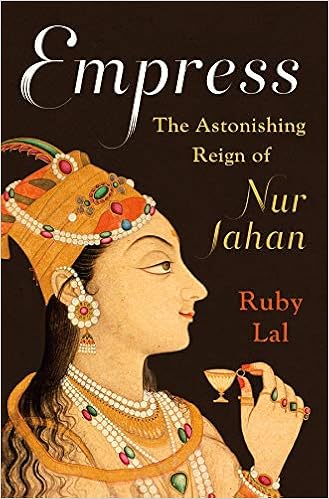
Review: Empress - The Astonishing Reign of Nur Jahan by Ruby Lal

"... finding her entails peering around the towering figures of men ..."


Nur Jahan was one of the most powerful and influential women in Indian history. Born amid a caravan traveling from Teheran to India, she became the last (eighteenth or twentieth) wife of the Mughal emperor Jahangir. When he succumbed to the effects of alcohol and drugs, she effectively took control of the government (1611-1627). Her reign is said to have marked the highpoint of the Mughal empire, during the course of which she made great contributions to the arts, religion, and the nascent trade with Europe. Her rise was swift - her downfall swifter, and she was effectively written out of Mughal history by Shah Jahan.

Ruby Lal's book is one of two biographies on this woman - the other being Ellison Banks Findly's Nur Jahan - Empress of Mughal India (which I haven't read, though a comparison between the two would be interesting). Lal says she is a feminist historian who is determined to "... tell the stories of women and girls, which are largely missing from the precolonial and colonial history of South Asia ..." - and this biography is written from a feminist viewpoint (more on that later). Her background in the study of Mughal history and culture serves her well, for the prose is very descriptive, so much so, you get a sense of actually being there.

We learn of a young girl (Mehrunissa) who meets Prince Salim (Jahangir) and they fall in love. Circumstance see her married to another, and it is only when Salim rebels against his father that they are brought together - her husband Ali Gurli was one of Salim's supporters. Upon his accession Saiem, now Jahangir, rewards her family where they take up positions within the new court. Mehrunsissa learns a lot during this period as her husband is often absent for a great portion of her marriage. When Jahangir's son rebels (1606 - 1607), Mehrusinssa's family falls under suspicion as does her husband, who later dies. Both she and her daughter are brought before the Emperor.

The trouble is, like most women whose voices are dimmed, sometimes there is just not a lot to write about and so we tend to hear more about them from the context of the males in their lives. For instance, we still don't really know how she rose to become the favoured wife - one out of many harem women. Nor the circumstances that led to her marriage to Jahangir in 1611.

We are told that she used her influence though patronage and family connections - her family had been firmly placed at the court of Jahangir's father Akbar and of Jahangir himself; her daughter from her first marriage, Ladl Begum, was married to Shahryar (d.1628) one of Jahnagir's sons (though not his successor). 

Following the deaths of both her parents Nur Jahan was left without a support network when another of Jahangir's sons - Khurram (Shah Jahan) - rebelled amid fears of being displaced in the line of succession (1622). Here, she is blamed for inciting sedition which resulted in the execution of Shahryar and a number of other princes. When Jahangir himself is captured (1626), it is Nur Jahan who engineers his rescue. However, her triumph was short-lived as Jahangir was dead the following year (1627) and Shah Jahan ascended the throne (1628). It is now that, despite her building works, that Nur Jahan fades from the pages of history (very similar situation to that of Hatshepsut of Egypt).


Lal is up front by claiming her biography of Nur Jahan is being written from a feminist viewpoint which essentially refers to the re-reading of history from a female perspective though sometimes interchangeable with feminist historiography, the restructuring of the history from the perspective of women. Why not just write a balanced (or as balanced as is possible) biography or history?  Why the need for terms and labels?

This biography however, is observational rather than factual. And it comes down to the sources used, which Lal claims, have been neglected and ignored by others - specifically Jahangir's own memoirs (wherein Nur Jahan is mentioned over 30 times) and the memoirs of Gulbadan Begum, whose descriptions of court life were extrapolated into / onto the life of Nur Jahan. Lal says she also made use later court histories and of the writing of those who visited the court: artists, tradesmen, diplomats, visitors and curious observers who were often ".. observing and assessing though his own cultural lens ..". Though how they had access to the imperial harem is a questioned I would love answered!

With nothing written in her own hand or by another expressing her own words, we know very little about this woman, except through the eyes of others. And Nur Jahan is not alone in this; there are many authors today, trying to piece together the fragmentary lives of notable women, to retell their stories from, I guess, a more retrospective and understanding voice. Some succeeded - others haven't.

There was still so much I wanted to learn about Nur Jahan that wasn't really covered here as the information was just not there. What Lal's book does do is gives us a fairly decent introduction into this woman. Lal says "... I didn't undo the legends. But I distilled them..." (CS Monitor 27th June 2018) - and sometimes, that is all we can do.

I will be looking forward to new forthcoming book on Gulbadan Begum, daughter of Mughal Emperor Babur (d.1556).  I am straying away from predominantly Euro-centric histories and seeking out more variety further afield.  Funny thing is - the stories are similar just different settings.  It really is a small world afterall.


Further reading:
Daughters of the Sun: Empresses, Queens and Begums of the Mughal Empire by Ira Mukhoty
Nur Jahan - Empress of Mughal India by Ellison Banks Findly
Private Life Of The Mughals Of India (1526-1803 A.D.) by R. Nath
Attendant Lords: Bairam Khan and Abdur Rahim, Courtiers and Poets in Mughal India by T.C.A. Raghavan
Baburnama by Zahiru’din Muhammad Babur Padshah Ghazi and trans. by Annette Susannah Beveridge
Akbar and The Rise of The Mughal Empire by GB Malleson
Light of the World”: The Life and Legacy of Nur Jahan (1577−1645) by Maggie Schuster

Nur Jahan (wikipedia)


Novels:
The Twentieth Wife by Indu Sundaresan (also: Feast of Roses and Shadow Princess)
Nur Jahan's Daughter by Tanushree Podder
Queen & Emperor: A Novel of the Mughal Empire by Tony Raosto

Review: Yellowthread Street by William Marshall


"... a world of surreal possibility recorded with unique humour and a poignant sense of humanity ..."

Yellowthread Street (A Yellowthread Street Mystery Book 1)
Set in a fictional suburb of Hong Kong, Chief Inspector Harry Feiffer and his motley crew of detectives are part of the night shift at Yellowthread Street Police Station. What begins as a routine night soon devolves into a comedy of errors and conversations lost in translation as the team investigate a bloody murder, a lost husband, a crime spree that coincides with the arrival of a US naval ship, a rampaging Mongolian, and local gangsters (with names like Osaka Oniki the Disemboweller, Shotgun Sen and The Chopper).

Loved every page ! Could not stop reading. It's hard to believe that this was first published in the mid-1970s, and is the first of many; and that it was a UK TV series in the 1990s (thank you youtube).

As I was reading this, it put me in mind of William Wyler's 1951 movie, "Detective Story", starring Kirk Douglas (that tells the story of one day in the lives of the various people who populate a police detective squad). Yellowthread Street seems to have been written in the same style.

Definitely a series to follow up on! 

See: